
Loading...
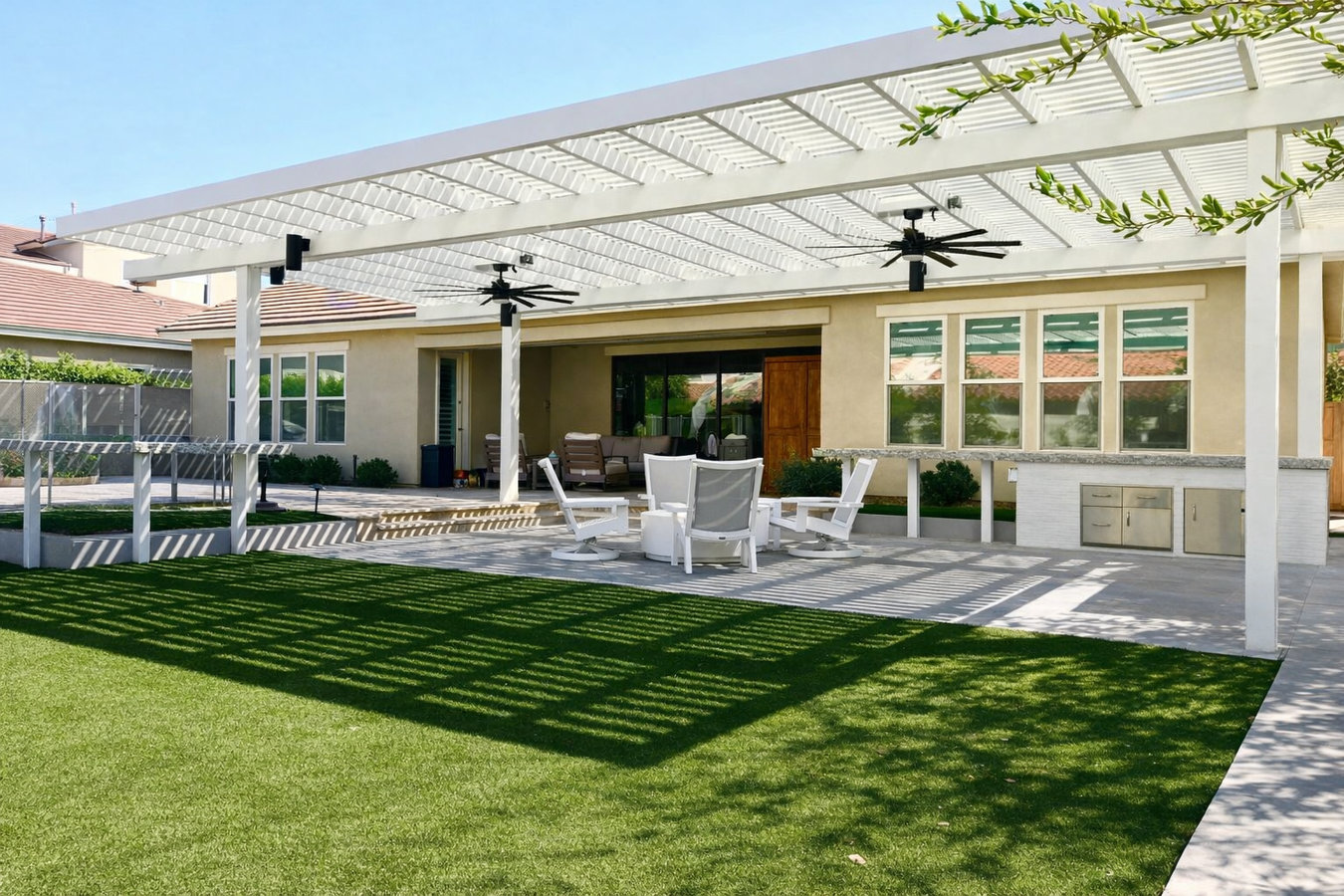
Your patio sits empty for five months because the Florida sun makes it unbearable. A properly built cover shades the space, handles afternoon thunderstorms, and gives you that outdoor room back - with permits and HOA handled for you.
Patio cover installation in Palm Coast takes one to four days of actual construction once permits are approved - the permit and HOA review process adds one to three weeks at the front end. Most homeowners in the area spend $5,000 to $15,000 depending on the size of the cover, the roof material, and any add-ons like ceiling fans or lighting.
A patio cover is a permanent roof-like structure attached to your home that shades your outdoor space. It can have a solid insulated roof panel system - which keeps the space underneath noticeably cooler - or a more open lattice style, depending on how much sun and rain protection you want. In Palm Coast, where afternoon thunderstorms roll through from June through September and the summer sun pushes surface temperatures well above 100 degrees, a solid insulated roof is the version most homeowners find most useful. Homeowners considering more complete weather protection may also want to review our page on screen room installation - a step up from a cover if you also want to keep out bugs and blowing rain.
The sections below walk through what signs point to needing a cover, what the installation process involves, and what to ask any contractor before you hire them.
If you step outside in the afternoon and immediately step back in, your patio is not working for you. Palm Coast's summer sun is intense enough that an uncovered concrete slab can reach surface temperatures well above 100 degrees, making furniture too hot to sit on and the space essentially unusable during the warmest months. A solid-roof cover drops the temperature underneath dramatically.
Constant UV exposure in a place with as much sunshine as Palm Coast breaks down outdoor fabrics, finishes, and even concrete sealers much faster than in northern climates. If you are replacing cushions every year or noticing your patio surface looking washed out, a cover would dramatically extend the life of everything underneath it - and pay for itself partly in what you stop replacing.
From June through September, Palm Coast gets storms that arrive fast and drop heavy rain with little warning. If you find yourself watching the sky every time you sit outside during summer, a solid-roof patio cover lets you stay outside through most of those storms. You get to enjoy the rain without getting soaked or scrambling to move furniture inside.
If you have an older aluminum cover that was installed without proper flashing, you may notice rust streaks running down your exterior wall, water stains on the ceiling of the covered area, or panels starting to bow or separate. These are signs the structure is failing and that water may already be getting behind your siding - a problem that gets more expensive the longer it goes unaddressed.
We install patio covers across a range of styles and materials - from solid insulated aluminum panel systems that keep the space underneath noticeably cooler, to open lattice designs that let in filtered light. Every project starts with a site visit where we measure the space, look at how the structure will attach to your home's exterior wall, and check what is underneath the slab - because Flagler County requires a utility locate before any footings are dug. Homeowners who want to take the next step beyond a cover can compare that option to our page on sunroom design - useful if you eventually want to add walls and turn the covered space into an enclosed room.
Proper flashing where the cover meets your home is the detail that separates a patio cover that lasts from one that causes problems. Water that gets behind the ledger board can work its way into the wall cavity and cause rot or mold over time - damage that shows up years after the cover was installed and long after the contractor has moved on. We use continuous flashing and seal every penetration before panels go on.
The most popular choice for Palm Coast summers - insulated panels keep the space underneath noticeably cooler than bare aluminum or polycarbonate alternatives.
Provides filtered shade and a traditional look at a lower price point - best for homeowners who want some sun protection without fully blocking natural light.
Adds electrical run, ceiling fan mounts, and lighting to a solid-roof cover - turns the covered patio into a usable outdoor living room after dark.
Removes and replaces an existing cover that is leaking, rusting, or improperly flashed - the right choice when the structure is failing and needs to be rebuilt to current wind standards.
Flagler County sits in a coastal wind zone that requires structures attached to homes to be rated for sustained winds of 130 miles per hour or more. That is stricter than what is required in many inland Florida counties and much of the rest of the country. Not every patio cover product sold nationally is approved for use here - and a contractor who pulls a permit in Flagler County is legally required to use materials that meet that standard. The Florida Building Commission maintains the product approval database where contractors can verify that the specific materials they are using are cleared for Florida's coastal counties - worth asking about when you compare estimates.
A large share of Palm Coast's housing stock was built during the ITT development era of the 1970s and 1980s using concrete block construction. Attaching a patio cover to a concrete block wall requires different anchors and hardware than wood-frame construction - a detail that out-of-area contractors sometimes underestimate. HOA requirements are another local factor: many of Palm Coast's planned communities require written approval before any exterior addition can begin, and some have rules about roof color, panel material, or the maximum size of covered structures. Homeowners in Palm Coast neighborhoods and nearby Ormond Beach communities should check their HOA documents before signing any contract.
We visit your home, measure the space, and look at how the structure will attach to your house. You will leave that conversation with a written estimate that breaks out materials, labor, and permits separately - not a single lump number. We reply within one business day to schedule your visit.
If your neighborhood has an HOA, we prepare and submit your architectural review request before the county permit application - because HOA approval has to come first. We handle both processes so you never have to track down forms or follow up with inspectors yourself. Expect one to three weeks for permit review.
Once the permit is approved, the crew anchors posts to footings, attaches the ledger board to your house wall, installs the roof framing, and lays the roof panels. Most standard patio covers are done in one to two days - larger or more complex structures may take three to four. We call for a utility locate before any footing work begins.
A Flagler County inspector verifies the structure was built to the approved plans. Once the inspection passes, we do a final walkthrough with you - checking that panels are seated evenly, flashing is tight against the wall, and the work area is clean. You get a copy of the closed permit for your records.
Free estimate, no obligation. We handle the permit, the HOA submission, and the installation - and we'll give you a written quote that breaks out every cost.
(386) 529-0493Every cover we install uses materials approved for Florida's coastal wind zone - verified through the Florida Building Commission's product approval database before we ever pull a permit. That is not a sales point; it is a legal requirement. A contractor who cannot show you the product approval for the system they are proposing is a contractor who may be cutting corners.
A large portion of Palm Coast homes are ITT-era concrete block construction, and attaching a cover to a masonry wall requires specific anchors and hardware. We have done this attachment type many times in this market. Contractors without that experience often underestimate the work or use hardware designed for wood framing - which is not appropriate for concrete block walls.
We file the Flagler County permit, schedule inspections, and - if your neighborhood has an HOA - prepare and submit your architectural review request before any work begins. You get a copy of the closed permit when the job is done, so there is nothing to disclose or explain if you sell your home.
The ledger board-to-wall flashing is where most patio cover failures start - water gets in, works behind the siding, and causes rot that shows up years later. We use continuous flashing and seal every fastener penetration. The National Association of Home Builders has documented that improper flashing is among the leading causes of moisture intrusion on attached outdoor structures.
A patio cover is a relatively straightforward project - but in Palm Coast, it has to be built right the first time. The wind requirements, the masonry attachment, and the permitting process here have real consequences if they are handled carelessly, and those consequences tend to show up at the worst possible moments.
Professional design service for homeowners planning a sunroom or enclosed addition - helps translate what you want into a buildable plan before construction begins.
Learn MoreA screen enclosure over your patio that blocks bugs and filters sun - a middle step between a bare cover and a fully enclosed room.
Learn MorePermit slots fill up heading into spring - lock in your project now so your cover is ready before the summer rainy season arrives.